|
A Pediatrician's Lifestyle / A Day In The Life of a Pediatrician
|
Thousands of hits a day come to YourPediatrician.com's Web site looking for information on the lifestyle of a pediatrician. Along with learning more about how to become a pediatrician, we receive extreme interest from potential pediatricians asking "could it be right for me?"
Well, here is your answer!
As a busy, practicing pediatrician in a suburban community, my experiences described here can give you a glimpse as to what it is all about.
|
|
The Good
The Not-so-good
The Bad
The Impact
The Good
 The appreciation that people have for being pivotal in helping their child become or stay healthy is really quite unparalleled in any profession. Any physician can experience the extreme satisfaction from helping their fellow man. But it is a unique dynamic when the parent (somewhat of a "proxy" for the child or infant), as a separate being, has the appreciation for partnering with you in helping their child get well. This concept of a parent choosing to work with you, their pediatrician, to help another human being adds a new dimension to the whole process - what I call the PEDIATRICIAN DYNAMIC. This is a concept that is unique to pediatricians (with the exception, maybe, of veterinarians, who have many similar dynamics in what they do). The appreciation that people have for being pivotal in helping their child become or stay healthy is really quite unparalleled in any profession. Any physician can experience the extreme satisfaction from helping their fellow man. But it is a unique dynamic when the parent (somewhat of a "proxy" for the child or infant), as a separate being, has the appreciation for partnering with you in helping their child get well. This concept of a parent choosing to work with you, their pediatrician, to help another human being adds a new dimension to the whole process - what I call the PEDIATRICIAN DYNAMIC. This is a concept that is unique to pediatricians (with the exception, maybe, of veterinarians, who have many similar dynamics in what they do).
The concept of publicly serving others while constantly learning and growing as an individual, is a wonderful part of being a pediatrician, and of being a doctor in general. You will feel great about knowing you are providing cheerful service to others as you grow your knowledge and skills personally. In this respect, medicine is a wonderful profession.
The income of a physician, and that of a pediatrician in particular, is not all the "glory" it used to be, but pediatricians have every reason to be financially successful in their careers. Many stressors on the medical system and the business of medicine have changed much of the income stature once enjoyed by physicians. This is not to say that you won't make a good living in medicine or pediatrics. All doctors that I've known closely have been successful in making a reasonable, if not very good, living. Of those with financial issues, it is not because they don't make enough money - but because they either do not manage or save the money they make very well. As a pediatrician, in particular, you need to be accepting that you will make less money than physicians in most other specialty areas.
The Not-so-good
Every profession has its shortcomings, and being a pediatrician is really no different. As in all areas of medical practice, as a physician you will be required to handle too much paper work and deal with what us clinical, non-administrators call the "bureaucracy of the business of medicine." It is a tricky act to keep juggling for long career - but when it comes down to just doing what is needed to get the care for your patients, it really becomes something you just do.
The hours become tough, especially "being on-call". It initially sounds exciting and glorious to be available at all times to help people, but it does become a bit tiring over time. This becomes somewhat of a psychological stress rather than a physical stress, given that over the last 20 years, technology of pagers, cell phone coverage and use, text-messaging, etc., are all means of getting in touch with a pediatrician without the 2 hour trip to the hospital or office. In this sense, the family life of a 2008 pediatrician is somewhat preserved.
Malpractice is a real problem in medicine, and does affect pediatrics (but not nearly as severely as in other specialties). I have had very caring and able colleagues go through medical malpractice law suits - some of these suits have been dropped, others settled for significant amounts of money. In all cases, it adds significantly to the stress experienced by a caring physician and is, unfortunately, a reality of medicine in America today.
Overall, the business aspect of medicine is often looked at as a shortcoming to purists. That is clearly a matter of experience and/or opinion.
The Bad
The downright "bad" part of being a pediatrician has to be the loss of a child's life, particularly once you've established a bond between the parent, family, and child. Anyone that goes into medicine hopes to help others. When you choose to specialize in pediatrics, you have in your heart the desire to help those that simply can not help themselves, and agree to giving something special of yourself to meet that need.
I remember one of my first experiences in residency when a young girl died. She was 7 years old and had been in and out of the hospital for many months of my training being treated for Acute Lymphocytic Leukemia (ALL). Although this particular form of childhood leukemia is now over 90% curable, 5-10% of children do not survive. During my training, ALL was only about 80% curable. .
I remember her being hospitalized for weeks at a time. As her first year resident doctor assigned to her, every day I would have to wake her up (along with her amazing, young mother) in the early morning. I'd have to draw blood from her central catheter. I'd have to respond to the nurse's page that the child is vomiting or has an itching rash due to her infusion of chemotherapy medicine. I had to perform spinal taps on her to administer "intrathecal" (into the spinal canal) medications to prevent relapse of disease. I had to perform painful bone marrow aspiration procedures. I had to (and gladly did so) get to know her as a person and as an incredibly positive spirit of life.
After about 4 months of this, she ended up in the ICU for a few days. While there, she suddenly died of an overwhelming infection (which we call sepsis). It was a complication of trying to kill her cancer - we had killed her immune system in the process of killing her cancer, and she could not overcome even the simplest of infections.
I remember bringing this stress home to my wife, and feeling no resolution in attending her family's celebration of her life (funeral), feeling depressed for weeks. I had allowed it to become personal, which is hard to avoid when you are a caring person.
Trying to explain to oneself why a child should struggle and die like this becomes a struggle for all pediatricians. It think all physicians go through this process at some point in their growth, but as a pediatrician it is a bit deeper. I suspect this is so because of the PEDIATRICIAN DYNAMIC that I mentioned above.
It is just a part of the job that pediatricians, as human beings, still have difficulty with. Don't fear it - just be as ready for it as possible.
The Typical Day
NOTE: this describes the typical day in the professional life of a practicing private pediatrician, not one in training.
 |
7am - rounds at the hospital. This is the time in which my hospitalized patients get my undivided attention to review what happened with them overnight, and plan for the day's tests and/or treatment plan. I see 1 newborn baby in the nursery that was delivered at 3 am. I spend 5 minutes examining her from head to toe, then spend another 10 minutes talking with the proud new parents, answering their questions and usually alleviating their concerns. This all needs to be documented in the patients hospital chart, so that takes another 5 minutes of either writing or dictating.
|
|
730 am - I see my 2 other patients in the hospital for illnesses. One is a 14 year old with acute arthritis involving his left knee (yes, children get arthritis too!). I review his blood counts, make sure his fevers have improved since starting him on antibiotics, and reviewing the results of the laboratory analysis of the fluid I removed from his knee with a needle the night before. He has an infection that will require me to get some help for my orthopedic colleague - so I spend the same 10-15 minutes as I spent with my exam and talk with the parents, as well as 5 minutes to call my surgeon friend to make sure he is evaluated for surgical drainage of the knee joint space later that day.
|
|
8 am - The ER called me 10 minutes ago to see a 4 year old with asthma. Although we try to keep kids with asthma out of the ER and out of hospital (by using preventive medications), once in a while they still have breathing difficulties. Because breathing is a rather vital part of living, I don't waste any time in getting to the ER to see the patient ( a little stressful, as I have patients at the office starting in 1 hr). I know his parents well, having managed his asthma care with every 3 month visits for the last 5 years. This is the first time he's needed to come into the hospital. He needs oxygen, breathing nebulizer treatments, and some IV steroid medications to reverse his breathing problem.
|
|
845 am - I stop by the x-ray department to review my x-rays for the day. This is often called "Radiology Rounds" and is a great way to review basic human anatomy and combine cool technology into helping patients. My boy with the knee joint infection had a bone scan yesterday to determine exactly where his infection was and where it wasn't. It was only in the knee joint, and did not involve the tibia bone below the knee. This is helpful to the orthopedic surgeon, in that she simply needs to drain the knee joint and we'll give him 3 week of antibiotics (instead of 6 weeks if it involved his bone structures).
|
While at radiology rounds, I pull up (on the computer screen, as x-rays are now all digital) the chest x-ray of the asthmatic 4 year old boy. He has no pneumonia, but clear evidence of "air trapping" consistent with a bad asthma flare. I now feel confident that there is nothing hiding in his lungs that I've missed on exam. He has a bad ashtma flare and nothing more that requires med to change my initial treatment plan.
|
9 am - I have patients at the office, scheduled for check ups, shots, rashes, sore throats, coughs, bloody diarrhea, and one child that needs medications refilled for anxiety/depression. They don't all arrive at 9, but are all scheduled between 9 and 10 am. Because I spent some unexpected extra time in the ER seeing the patient with the "rather important breathing problem", I am not getting started in the office until 915, so I'm already behind!
|
|
1130 am - my stomach growls, after seeing 8 patients. I'm finishing up suturing a 6 year old boy's upper lip - something that a plastic surgeon might often do, but I felt obligated to give it my best shot, as the family did not have insurance and could not afford the $ 500 bill of a plastic surgeon. After placing one deep suture and 5 very tiny superficial stitches in the child's lip, I'm pretty happy with how it came together. The important thing to get lined up is the "vermilion border", where the lip color changes to normal pink skin. It approximated very nicely. Not bad for a pediatrician! I arrange with my billing office to have my usual charge of about $ 250.00 dropped to $ 150.00 to help out the family.
|
|
12-1pm - I spend my lunch with a community civic group that focuses on "Helping the Children of the World". I've been a member of this club for most of my career, and enjoy the friendships I've made outside of the medical field. It is mostly accountants, bankers, secretaries, lawyers, policemen, etc. It is a nice "break" from my professional rigors.
|
|
1 pm - I get back to the office to return phone calls from the morning. While I was seeing patients, over 100 phone calls and faxes came in to the office. Some for appointments, some asking for results of their lab tests, some for prescription refills, and most for advice on their kid's care. I have review with my nurses what to do with each case, after reviewing their concern and their specific medical record. I also call my wife to let her know I can pick up my daughter at school when I'm done in the office!
|
|
2-4 pm - Patients are scheduled for the afternoon session, just as in the morning. More phone calls come in that need attention. I'm on schedule and it is 320pm. I have a call on line 3 from our hospital's obstetrician. He has a patient in labor that is having problems, so I need to come help out after the baby is born.
|
Just as I had to urgently take care of the child with asthma in the ER earlier in the morning, this problem can't wait either. I must have my 3 patients that I was to see in the office between 330 and 4pm reschedule, because I am now off to the hospital.
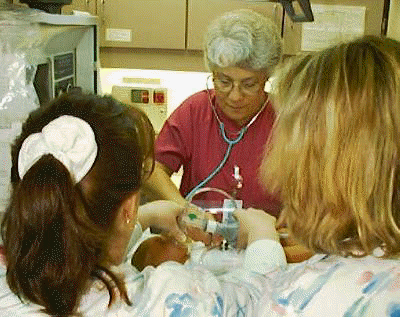
I sign into the operating room where the C-section surgery was started by the obstetrician 10 minutes ago. The baby will be out in 5 more minutes, so I quickly dress into sterile clothing and gloves and am ready to play "receiver of a baby". Because the mother was having problems during labor, the status of the baby was somewhat concerning to the obstetrician. I don't know how the baby is until after the obstetrician cuts the cord and places the baby in my arms ... a little more stress!
This baby has good tone/strength initially, but is not really interested in taking any breaths! That is not good! So, with the help of a trained nurse, I initiate resuscitation maneuvers to "jump start" this baby to breath. After quickly suctioning the baby's mouth and nose, I immediately place a bag/mask with oxygen over the baby's face and begin breathing for the baby. We count, one, two, three, etc. After about 30 seconds of this, the baby begins to fight back, begins to cry, and "wakes up". I then turn the care of the newborn (that is now stable) over to the nurse to continue to observe and treat the baby during this important initial adjustment period.
|
5 pm - After changing back into my shirt and tie, dictating my care of the newborn, I get back to the office by 5pm. After reviewing end-of-the-day items with my office staff, I depart to pick up my daughter from school. I'm about 30 minutes later than I had planned, but she is used to me being occasionally redirected at work and being a bit late.
|
|
6-8 pm - For 15 years, I've always taken a couple of hours out of the evenings to spend dinner with my family. My wife has made this a priority, and, over the years, I've come to appreciate this time together. I may be a little late to pick up my child; I may have to reschedule a few patients each day because of urgent surprises that arise at the hospital or office; but my family can pretty much count on me being at dinner.
|
After dinner, I may have to make a trip back to the office or hospital to tidy up the day, and ensure everything that a patient needs that day has been completed. Much of this can be completed over the phone, so I can still be with my family. But tomorrow night, I am "on-call" for my 4 physician call group - and I will likely be in and out of the hospital, the ER, and on and off the phone much of the evening. That is the one night a week that my family doesn't expect me for dinner, but is occasionally surprised with my presence when things are quiet.
Because of the after-hours and night time schedule on this "on-call" night, I work a very limited office schedule the next day. This allows for sleep recovery, for personal chores to be tended to, and any other office or hospital administrative work to be completed.
The Impact
Every night before going to sleep, I focus on the overall tasks of my day, both personal and professional. It is very rare that such self-reflection does not give me a feeling of being thankful for the positive impact I had on patients and their families that day. I helped, and may have actually saved the life of the breathless baby at the C-section; I hopefully directed the care of the boy with arthritis to promptly get his knee surgery and start his recovery to playing basketball again; I helped reassure a worried mother that her hospitalized 4 year old with asthma will start to feel better very quickly with oxygen and medications I quickly started. Oh - and I helped a little boy keep his great smile, while saving his father a few hundred dollars!
A pediatrician's impact is often profound, even if only considered "all in a day's work".
That is probably why I sleep quite soundly most nights, as long as I don't get any middle-of-the-night phone calls from the hospital ER doctor!
Steven J. Halm, DO, FAAP, FACP
Pediatrician/Internist
Founder, Editor - YourPediatrician.com, Inc.
|




